

Disclaimer: This information is for educational purposes only and does not constitute medical advice. If you are experiencing concerning symptoms, please consult a healthcare professional.
Many people brush off leg pain as “getting older” or just “being on my feet all day.” But your legs can be the first messenger of a struggling heart.
Heart failure leg pain doesn’t usually feel like a pulled muscle or a sharp cramp. It feels like pressure.
Heart failure doesn’t always start with clutching your chest. Often, it starts silently in your feet, ankles, and calves. By the time you feel short of breath, the fluid buildup might already be severe.
In this guide, you will learn exactly what this “cardiac ache” feels like. We will walk through the early signs of heart disease you can spot in the mirror, how to perform the simple “Finger Press Test” at home, and the critical 3-Day Rule for seeking help.
The “Silent” Connection: Why Your Heart Hurts Your Legs

To understand why your legs hurt, you have to look at your heart as a pump.
Your heart’s job is to push blood out to your body and then pull it back up against gravity to be re-oxygenated. When the heart weakens, it can still push blood out, but it struggles to pump it back up effectively. This is called venous congestion.
Because the pump is weak, blood backs up in the veins. Then, gravity takes over. Fluid leaks out of the veins and settles in the lowest part of your body, your legs.
Why does it hurt?
This isn’t usually a sharp pain. It is fluid retention (medically known as edema). The pain comes from pressure. As fluid fills the tissues, your skin stretches tight. It can feel like your legs are heavy, bursting, or aching deeply.
The Gravity Effect
You might notice your swollen ankles are fine in the morning but look twice as large by bedtime. That is gravity at work. After you lie flat all night, the fluid redistributes. After standing all day, it sinks back down.
Key Stat: According to medical data, peripheral edema (leg swelling) is present in up to 70% of patients hospitalized for acute heart failure.
The 3 Specific Signs of Cardiac Leg Pain

Not all leg pain points to the heart. But heart failure leg pain has a specific “signature” look and feel. Watch for these three signs.
1. Bilateral Presentation (Both Legs)
This is a major clue. If only one leg is swollen and painful, it might be an injury or a blood clot. Because the heart pumps for the whole body, heart failure usually causes bilateral leg swelling. Both ankles or calves will look puffy at the same time.
2. The “Sock Line” Indicator
Do you have deep grooves around your ankles when you take off your socks? Do those marks stay there for several minutes?
In a healthy person, sock marks disappear quickly. If the indentation stays, it means your tissues are waterlogged. This is a classic sign of ankle edema.
3. Shiny, Stretched Skin
When fluid builds up, it pushes against your skin from the inside.
- The skin may look glossy or shiny.
- It feels tight to the touch, like a balloon ready to pop.
- You might notice hair loss on your shins because the skin is stretched too thin to support hair follicles.
Tight skin symptoms are uncomfortable and a clear signal that fluid is trapped where it shouldn’t be.
The “Finger Press Test” (How to Check for Pitting Edema)
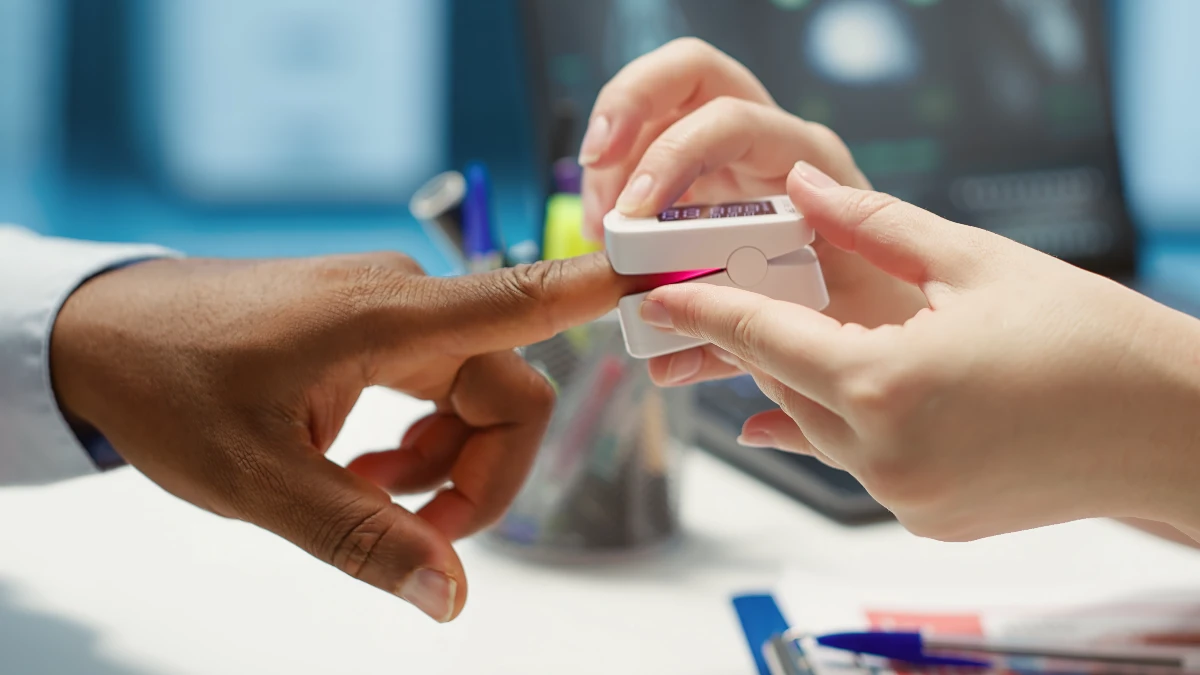
You don’t need expensive equipment to check for fluid retention. You can use the Pitting Edema Test. Doctors use this exact method to gauge fluid overload.
How to do it:
- Sit down and prop your leg up.
- Find a bony area on your shin (the front of your lower leg) or the top of your foot.
- Press your thumb firmly into the skin for 10 to 15 seconds. You need to use steady pressure.
- Release your thumb.
- Look and feel. Is there a dent (or “pit”) that stays behind?
What it means:
If the skin bounces back immediately, that is normal. If your thumb leaves a dimple that takes a few seconds (or minutes) to disappear, that is positive pitting edema.
Doctors grade this on a scale from 1+ (mild dent, bounces back quickly) to 4+ (very deep dent, stays for minutes). You don’t need to grade yourself, but you do need to know that a lasting dent is a sign of a home heart health check you shouldn’t ignore.
Heart Failure vs. Other Leg Pain (Is it DVT or Arthritis?)
Heart Failure
DVT (Clot)
Arthritis

It is easy to confuse heart swelling with other common issues. Here is how to tell the difference between DVT vs heart failure or arthritis.
Note: Leg pain causes vary. If your leg is red, hot, and painful in just one spot, seek medical help immediately, as this could be a blood clot.
The 3-Day Rule: When to Call the Doctor

Fluid builds up inside you before it shows up on your ankles. That is why the scale is your best early warning system.
The “Weight Gain” Warning
If your heart slows down, your kidneys respond by holding onto salt and water. This adds weight fast.
Follow the 3-Day Rule:
Weigh yourself every morning after using the bathroom but before eating. Call your doctor if:
- You gain more than 2-3 lbs in 24 hours.
- You gain more than 5 lbs in a week.
This is rarely “fat” gain; it is fluid weight.
Red Flags (When to Call 911)
Rapid weight gain heart failure symptoms are urgent if they come with breathing trouble. Seek emergency care if you have:
- Shortness of breath while lying flat (you have to sleep propped up on pillows).
- Waking up in the night gasping for air.
- Persistent coughing with pink, frothy mucus.
- Chest discomfort or pressure.
These are emergency heart symptoms indicating fluid is filling your lungs, not just your legs.
Conclusion
Your legs are often the first place to show that your heart needs help.
This heaviness isn’t a muscle problem; it’s a volume problem. The good news is that congestive heart failure prevention and management are very effective when you catch them early. Often, a doctor can adjust your medication (like diuretics) to help your body shed the excess water, stopping the issue before it lands you in the hospital.
Your Next Step:
Check your ankles tonight. Take off your socks and look for the lines. Do the Finger Press Test. If you see the “dent” or have noticed sudden weight gain, book an appointment with your primary care doctor this week.