

You’ve spent decades building a foundation of strength, but by the time you cross the age-50 threshold, your biology has changed. While your drive remains, your tendons are no longer the elastic bands they were at 25. Research from Brown University Health indicates that degenerative changes in the rotator cuff are a natural part of aging, with the prevalence of tears increasing significantly after 50.
The primary issue is the subacromial space. This tiny gap in your shoulder joint houses the supraspinatus tendon. As we age, natural collagen loss and postural shifts can narrow this space. When you perform high-risk “legacy” exercises, you essentially “pinch” these delicate structures, leading to chronic inflammation or a sudden tear.
1. Behind-the-Neck Lat Pulldowns

The behind-the-neck lat pulldown is a relic of the “Golden Era” that modern biomechanics has largely debunked for the aging lifter. To get the bar behind your head, your humerus must move into a position of extreme external rotation and abduction.
Why it’s dangerous
This position places the greatest amount of stress on the weakest part of your joint capsule. In men over 50, the supraspinatus tendon, which accounts for nearly 70% of all rotator cuff issues, is forced to rub against the acromion bone. Furthermore, most lifters must tuck their chin forward to clear the bar, which creates unnecessary shear force on the cervical spine, potentially leading to disc herniation.
Front Lat Pulldown (Neutral Grip)
Instead of a straight bar, use a “V-bar” or a multi-grip attachment. Pulling to the upper chest while keeping your palms facing each other (neutral grip) keeps the shoulder in a “packed” position and significantly increases the subacromial space.
2. Upright Rows

The Upright Row is often called the “ultimate shoulder wrecker” by physical therapists. It forces the shoulder into a combination of internal rotation and elevation, the exact position used by doctors to test for shoulder impingement (the Neer Test).
The Mechanical Nightmare
When you pull a barbell vertically with a narrow grip, the “greater tuberosity” (a bump on your upper arm bone) smashes into the acromion. This occurs most aggressively in the “Painful Arc”, the zone between 60 and 120 degrees of abduction. For a 50-year-old man, this repetitive “grinding” can turn a minor fray into a full-thickness tear over time.
High-to-Low Cable Rows or Face Pulls
If you want to target the traps and lateral deltoids, use face pulls with a rope attachment. By pulling toward your forehead and focusing on “peeling” the rope apart, you achieve external rotation at the top of the movement, which clears the joint and protects the cuff.
Expert Insight: Physical therapists like Dr. Grayson Wickham emphasize that rounding the shoulders forward during this move (a common compensation) accelerates labrum wear.
3. Overhead Barbell Military Press

While the military press is a legendary strength builder, its “fixed path” is its greatest flaw. Because a barbell is a solid, straight object, your shoulders are forced to move around the bar, rather than the bar moving around your natural anatomy.
The “Fixed Path” Problem
Most men over 50 have some degree of thoracic (mid-back) stiffness. When you can’t extend your mid-back, your shoulders compensate by hyperextending at the joint to get the bar overhead. This places massive pressure on the Acromioclavicular (AC) joint, leading to “weightlifter’s shoulder” or distal clavicle osteolysis.
Neutral Grip Dumbbell Press (Scapular Plane)
Switch to dumbbells and move your elbows forward about 30 degrees (into the “scapular plane”). This allows the shoulder blade to move naturally along the ribcage. Using a neutral grip (palms in) further opens the shoulder joint, making the move feel “buttery smooth” even with heavy loads.
4. Deep Bench Dips
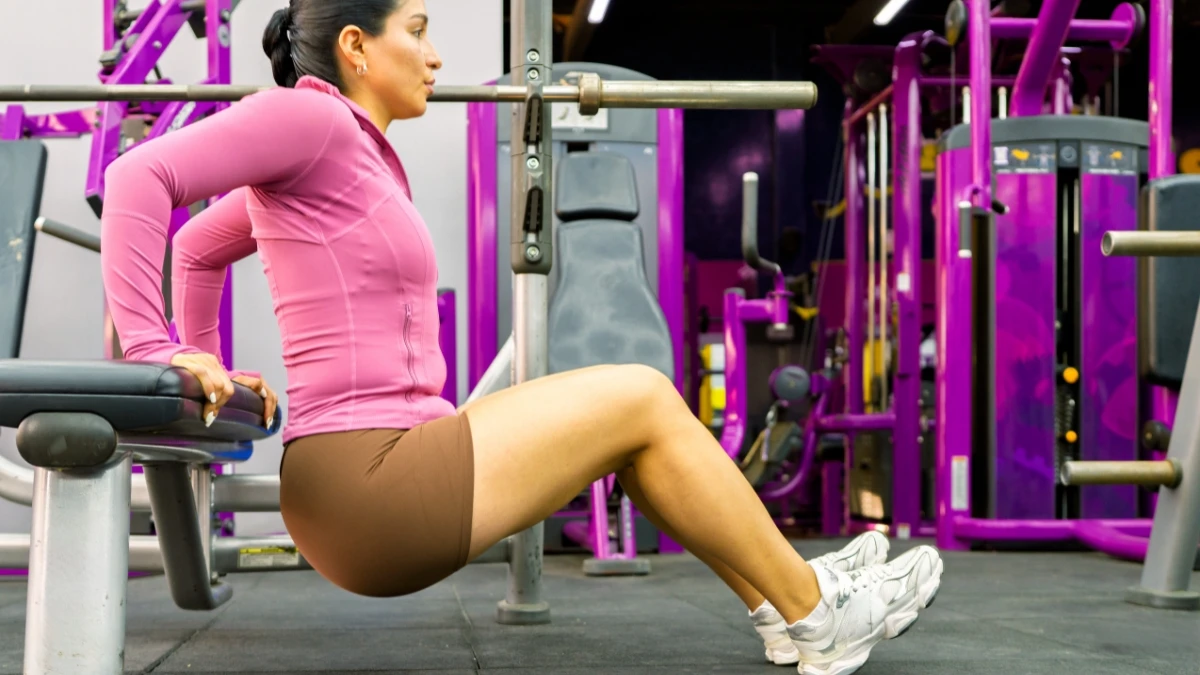
Bench dips (where your hands are behind you on a bench) are arguably the most deceptive exercise in the gym. They feel like a great triceps builder, but the cost to the anterior shoulder is immense.
Shearing the Labrum
In this position, your shoulders are in extreme extension and internal rotation. As you lower your body, the head of the humerus (upper arm bone) wants to glide forward, “shearing” against the front of the shoulder capsule and the labrum. For men over 50, who may already have minor joint instability, this is a recipe for a labrum tear or bicep tendonitis.
Cable Triceps Pushdowns
Use a cable machine with a straight or V-bar. By keeping your elbows pinned to your sides, you isolate the triceps without putting any load on the shoulder’s capsule. If you want a “pressing” feel, perform a Close-Grip Floor Press, where the floor acts as a natural safety stop for your elbows.
5. Full-Range Barbell Bench Press
Touching the chest pries the shoulder joint open. Most rotator cuff injuries happen during the initial drive.
100% RiskThe floor stops your elbows at torso level. This limits motion to the safest, strongest part of the lift.
Longevity Standard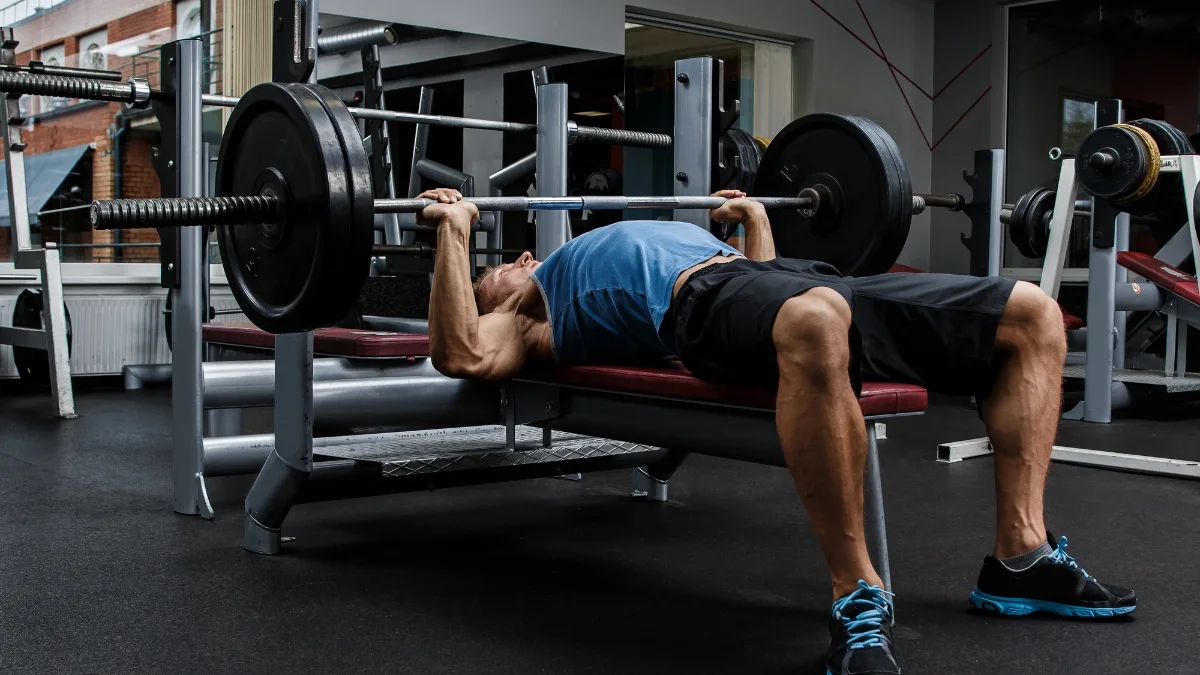
The “touch the chest” rule is a powerlifting standard, not a longevity standard. For men over 50, the bottom two inches of the bench press offer very little extra chest activation while offering 100% of the risk.
The “Bottom End” Danger
When the bar touches your chest, your humerus is pulled back past the neutral point of the torso. This creates a “lever” effect that pries the shoulder joint open at the front. According to a 2025 study on masters athletes, most bench-press-related rotator cuff injuries occur during the initial drive off the chest when the tendons are at their most stretched and vulnerable.
Dumbbell Floor Press
Perform your presses while lying on the floor. The floor will stop your elbows exactly when they reach the level of your torso. This “limits the range of motion” to the safest part of the lift, allowing you to go heavy on your chest and triceps while keeping your rotator cuffs completely out of the “red zone.”
Conclusion
Training in your 50s and beyond is about strategic substitution. You don’t have to stop lifting heavy or building muscle; you simply have to stop using tools that fight your anatomy. By swapping fixed-barbell movements for dumbbell and cable variations that respect the “scapular plane,” you ensure that your gym time builds you up rather than wearing you down. Remember: Longevity is the new “Personal Best.”
By identifying these rotator cuff exercises to avoid, you are investing in a future of pain-free mobility. Ready to bulletproof your joints? Download our “Joint-Friendly Muscle Builder” PDF below to get a full 4-week program designed for the over-50 athlete.